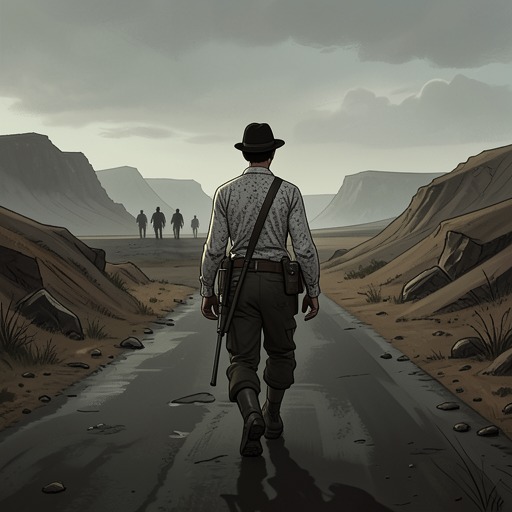
Albuquerque
Earth AbidesAlbuquerque matters as more than a point on a map: Ish’s route planning makes it a hinge between the desert roads of the West and the open country farther east, while the boys’ account of a community near it shows how differently survivors have organized their lives.
A landmark on Ish’s planned route
When Ish considers traveling east to find other survivor communities, he weighs the obstacles on the roads. He expects routes over the Sierra Nevada and to the north to be blocked by fallen trees and landslides, so he favors the more open country to the south. His remembered route leads across the Colorado River and toward Albuquerque, where the Rio Grande presents another major crossing. Beyond Albuquerque, he expects that getting through the Sandia Mountains would open onto plateau country and, farther east, a growing choice of roads. The route is a plan, not a guarantee: bridges may have fallen, and the only way to learn what remains passable is to go and see.
Ish’s planning turns Albuquerque into a threshold between uncertain mountain crossings and a more open eastward passage. He believes that even after twenty-one years, the great highways will not be entirely blocked; with the jeep, travelers might manage fallen trees or clear a track across a landslide. Yet the landscape also exposes a gap between the old map and the changed world. When Ish warns the boys that they may have trouble in Arizona, Bob asks what Arizona is. Ish cannot readily explain what a state had been, or what such a place-name means after the former political order has vanished.
The community near Albuquerque
The boys’ journey gives Albuquerque a second, more human association. They describe a community at one of the old Indian pueblos near the city, with a few dozen people whose pattern of life centers on growing corn and beans, as Pueblo communities had done for many centuries. Ish infers that the community’s dominant spirit is Indian, though he also understands from their description that most of its members are not very dark in complexion. Only some of the older people speak English.
This community has turned inward and looks suspiciously on strangers. Its people keep horses, do not drive automobiles, and rarely go into any town. These details distinguish it from a society organized around cars and travel: here, farming and local life shape the community’s daily pattern, while limited use of English and wariness toward outsiders mark the boundaries around it.
From planned passage to reported encounter
Ish first treats the Albuquerque region as a place to cross on a future search for communities, urging the boys to look for groups rather than isolated survivors and to learn how they are solving their problems and starting again. Their account makes that search concrete. After leaving the community near Albuquerque, they turn north to Denver and then travel east across the plains. The route thus links Ish’s inherited geographical knowledge to the boys’ actual journey, but the community they encounter is not simply a stop on a road: it represents one local response to a world in which familiar institutions, vehicles, and ways of communicating have lost their former reach.